
Retirement Then, Now, and Next
RELAB POLICY NOTE
(800 KB)
This policy note is part of SCEPA’s “Tracking the Retirement Crisis” series. This series was made possible in part through the generous support of The James Family Charitable Foundation and the Social Security Administration (RDRC23000009-01-00 and RDRC23000009-02-00). We are deeply grateful for their commitment to supporting our work and advancing research in this field.
Elevator Pitch: Late Baby Boomers, Generation X and Millennials are retiring under worse conditions than Early Baby Boomers. Later generations will likely face even worse retirement conditions due to pending and proposed policy changes. In order to provide later generations with the same level of retirement security as Early Baby Boomers, Congress must act to increase Social Security revenue, expand Medicaid and Medicare, and rebuild trust in the retirement system.
Late Baby Boomers (age 59-67), Generation X (age 43-58) and Millennials (age 27-42) are retiring under much worse conditions than Early Baby Boomers (between age 68-76 in 2022). This fact gets obscured by research that paints an optimistic picture of retirement security that only really existed for Early Baby Boomers. Later generations have been impacted by changes to the conditions of retirement that Early Baby Boomers did not experience. This includes: the shift from defined benefit (DB) plans to defined contribution (DC) plans; increasing instances of debt; financial strain due to increased longevity; and rising medical and long-term care costs.
This edition of Tracking the Retirement Crisis from SCEPA at The New School summarizes our research on the past, present, and future of retirement security.1 It examines how retirement outcomes have varied across generations and considers how current legislation may affect future retirees.
Retirement Then and Now
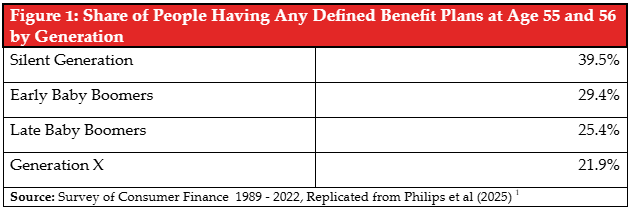
The decline of defined benefit (DB) pension plans across generations has led to a significant erosion in retirement security: the share of DB plans at age 55 and 56 held by each generation declined from 39.5% for the Silent Generation (between ages 77 - 94 in 2022) to 21.9% for Generation X (see Figure 1). The loss of valuable DB plans means the loss of access to lifetime income and immunity from market volatility.
Figure 1: Share of People Having Any Defined Benefit Plans at Age 55 and 56 by Generation
By contrast, defined contribution (DC) plans - such as 401(k)s and IRAs - are experiencing little growth in participation but an increase in average account value (estimated at $125,900–$127,745 in 2025).1 However, these assets are much more unevenly distributed. Higher-income individuals in younger cohorts have managed to save more through DC plans, but most households—especially those below the 60th percentile - have not. For most groups, the amount saved is far less than the equivalent estimated value of a DB plan.
This shift matters. DC plans depend on market performance, personal investment decisions, and stable employment - factors that introduce significant risk as discussed in a previous retirement tracker.2 Workers often choose DC plans based on overly optimistic expectations about returns and without accounting for volatility or longevity risk. An analysis of real-world data found DB plans were more effective, especially for Black workers and those with lower financial literacy.3 DB participation boosted wealth by up to 50%. The disappearance of DB pensions, then, represents not just a shift in retirement planning - but a loss of guaranteed, equitable, and resilient retirement income for millions.
Surprising Levels of Debt Among the Elderly
Most retirement income projections overlook debt levels and distribution. Later generations are increasingly likely to carry debt into retirement which affects their retirement savings. The share of seniors in their 60s with mortgages grew from 25.1% in 1989 to 40.7% in 2022 (see Figure 2). Additionally, the distribution of households with debt has a racial component - Black and Hispanic households with mortgages in retirement have lower median financial assets.4
Figure 2: Percentage of Seniors Age 60+ with Mortgages in 1989 and 2022
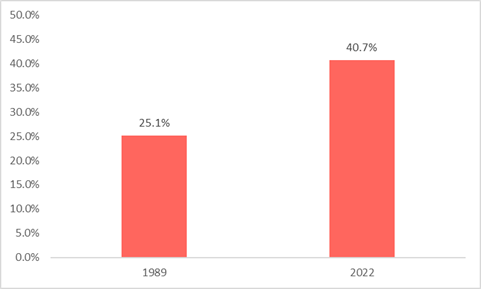
Source: Survey of Consumer Finance 1989 - 2022, Replicated from Philips et al (2025) 1
Another concern is that other forms of debt including student loans now factor into retirement planning; the share of older households with student debt has increased between 1989 and 2022 (see Figure 3).
Figure 3: Percentage of Older Households with Student Loans in 1989 and 2022
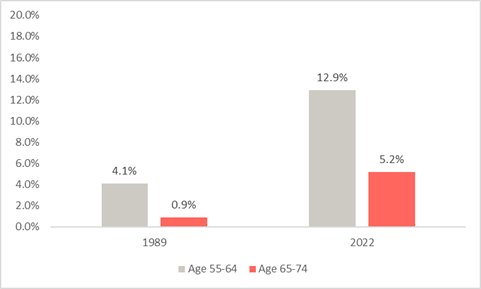
Source: Survey of Consumer Finances 1989-2022
Longevity: The Good News is Bad News
An ostensibly positive development - increases in longevity - poses a challenge to retirement security for later generations. Life expectancy has increased significantly - by 13.9% for Generation X men in comparison to Early Baby Boomers, and by 10.1% for women. This means that in order to ensure that their total savings covers their entire retirement period, Gen X men must save nearly 14% more for retirement than their predecessors, and women about 10% more. Living longer means financing more years of uncertain expenses, from unexpected medical expenses to increases in cost of living. This increases this risk of outliving defined contribution savings – especially during financial downturns. Ironically, lower-income workers may appear more “secure” simply because they tend to die younger and spend less time in retirement.5
It is often assumed that increasing longevity implies that people can work for longer in their lives, but this ignores evidence that healthy working years – the number of years older people can expect to live without a disability or chronic disease – have declined.6 Between 2002–2007 and 2014–2017, healthy working-life expectancy for men aged 51–65 fell by 12.7%, and for women by 3%.7
In short, rising longevity intensifies both the need for greater retirement savings and the uncertainty surrounding how long those savings must last, and the shortfall in savings may not be able to be covered by working given the estimated reduction in healthy working years.
Later generations will likely suffer increasing and large out-of-pocket healthcare expenses not covered under Medicare including co-pays, premiums, and supplemental insurance.8 These amounts are not small, with lifetime post-retirement medical expenses being around 127,000 for a 65-year old man 143,000 for a 65-year old woman.1 Out-of-pocket long term care services are also a major cause for concern; private long-term care is uncommon, and Medicaid only kicks in once people’s assets are depleted.
Retirement Next: Increasing Fragility Due to Current Policy Considerations
The current conditions for retirement are poor, and SCEPA’s previous retirement tracker indicates that Americans are responding to the eroding trust in Social Security by claiming benefits early.9 What can future generations expect? Legislation that has been passed – such as in the Federal Budget Reconciliation Bill - suggests not a lot. Without interventions, the Social Security Trust Fund will be insolvent by 2033, leading to an automatic reduction in benefits by about 23%.10 Beyond this, the conditions of retirement are likely to get worse as other parts of the system are undermined. Projected cuts to Medicare and Medicaid on the basis of deficit reduction will further stretch already inadequate savings. The resumption of student loan repayments will further help the debt creating institutions overwhelm wealth creating institutions. Increases to the retirement age will push people to work longer even when their bodies are not able to, creating gaps in retirement access.
Policy Recommendations
Congress and the President must act to ensure that the affordable and stable retirement experienced by Early Baby Boomers can be extended to future generations. Strengthening Social Security requires increasing revenue, not cutting benefits. An easy (and effective) way to do this is to increase the Social Security earnings cap (set at $176,100 in 2025) in order to boost revenue and enable the program to meet and expand its obligations. Social Security can also be strengthened by reversing planned layoffs and restoring Social Security Administration (SSA) staffing to meet growing demand, canceling planned SSA office closures, and modernizing the agency’s infrastructure in a careful and secure manner. Rebuilding public trust in the system requires maintaining stable operations, clear communications, and professional stewardship.11
Other policy measures include:
- Implementing the Retirement Security Act for Americans (RSAA),12 which proposes universal retirement savings accounts to supplement Social Security and increase wealth accumulation. These portable, tax-advantaged accounts would be available to all workers, including part-time and gig workers who often lack access to employer-sponsored plans.
- Lowering the Medicare eligibility age from 65 to 60,13 which could reduce healthcare spending during a critical pre-retirement period.
- Expanding on prescription drug pricing caps that had initially been implemented via the Inflation Reduction Act of 2022.14
- Passing the Better Care Better Jobs Act15 to improve access to Home and Community-Based Services (HCBS), reducing costs for seniors who prefer non-institutional care.
Urgent reform is needed to avoid a further decline in retirement security. Proactive policy changes now can distribute costs more fairly and leverage long-term gains through compound interest, securing retirement for future generations.
References
1. Phillips, D., Ghilarducci, T., & Manickam, K. (2025). Retirement Then and Now: Shortfalls in the Retirement System Will Fail Many Future American Retirees. The Journal of Retirement, 12(3), 30–43. https://doi.org/10.3905/jor.2025.1.175
2. SCEPA Research Team. (2025). America’s Retirement Crisis Hits a Breaking Point. Schwartz Center for Economic Policy Analysis. https://www.economicpolicyresearch.org/resource-library/america-s-retirement-crisis-hits-a-breaking-point
3. Madland, D., Weller, C., & Shiva, S. (2024, March 20). Unions Continue To Build Wealth for All Americans. Center for American Progress. https://www.americanprogress.org/article/unions-continue-to-build-wealth-for-all-americans/
4. Friedberg, L., Sun, W., & Webb, A. (2023). The House: Is it an Asset or a Liability? [Working Paper]. https://doi.org/10.7302/23463
5. Baars, J. (2022). Long lives are for the rich: Aging, the life course, and social justice. Routledge.
6. Boissonneault, M., & Rios, P. (2021). Changes in healthy and unhealthy working-life expectancy over the period 2002–17: A population-based study in people aged 51–65 years in 14 OECD countries. The Lancet Healthy Longevity, 2(10), e629–e638. https://www.thelancet.com/journals/lanhl/article/PIIS2666-7568(21)00202-6/fulltexthttps://www.thelancet.com/journals/lanhl/article/PIIS2666-7568(21)00202-6/fulltext
7. Healthy life expectancy declined for men from 3.68 to 3.21 years, and for women from 2.65 to 2.56 years.
8. Hatfield, L. A., Favreault, M. M., McGuire, T. G., & Chernew, M. E. (2018). Modeling Health Care Spending Growth of Older Adults. Health Services Research, 53(1), 138–155. https://doi.org/10.1111/1475-6773.12640
9. SCEPA Research Team. (2025). Loss of Trust in Social Security Jeopardizes Americans’ Retirement Plans. Schwartz Center for Economic Policy Analysis. https://www.economicpolicyresearch.org/resource-library/loss-of-trust-in-social-security-jeopardizes-american-s-retirement-plans
10. Press Office, Social Security Administration. “Trustees Report Summary.” Social Security Administration, https://www.ssa.gov/oact/trsum
11. SCEPA Research Team (2025). Trump Can Rebuild Trust in Social Security By Reversing Layoffs and Office Closures Before it's Too Late. Schwartz Center for Economic Policy Analysis. https://www.economicpolicyresearch.org/resource-library/trump-can-rebuild-trust-in-social-security-by-reversing-layoffs-and-office-closures-before-it-s-too-late
12. Hickenlooper, J., T. Tillis, L. Smucker, and T. Sewell. (2025). “Hickenlooper, Tillis, Smucker, Sewell Reintroduce Bipartisan Bill to Help Americans Save for Retirement.” Senator John Hickenlooper. https://www.hickenlooper.senate.gov/press_releases/hickenlooper-tillis-smucker-sewell-reintroduce-bipartisan-bill-to-help-americans-save-for-retirement/
13. Jayapal, P. (2021). “Improving Medicare Coverage Act, H.R. 5165, 117th Cong. 1st Sess.” Congress. https://www.congress.gov/bill/117th-congress/house-bill/5165?s=1&r=2
14. Cubanski, J., Neuman, T., & Freed, M. (2023). Explaining the Prescription Drug Provisions in the Inflation Reduction Act. KFF. https://www.kff.org/medicare/issue-brief/explaining-the-prescription-drug-provisions-in-the-inflation-reduction-act/
15. Caldwell, J. (2021). Better Care Better Jobs Act: Historic Investment to Improve Access to Home and Community Based Services and Strengthen the Workforce. Community Living Policy Center. Brandeis University, Waltham, MA. https://doi.org/10.48617/rpt.315