
Trump Can Rebuild Trust in Social Security By Reversing Layoffs and Office Closures Before it's Too Late
RELAB POLICY NOTE
(1.4 MB)
This policy note is part of SCEPA’s “Tracking the Retirement Crisis” series. This series was made possible in part through the generous support of The James Family Charitable Foundation and the Social Security Administration (RDRC23000009-01-00 and RDRC23000009-02-00). We are deeply grateful for their commitment to supporting our work and advancing research in this field.
Elevator Pitch: In just eight weeks, the trust that Social Security has built over the past 90 years may have been completely undermined. To restore Social Security, it is essential for Congress and the President to act quickly to strengthen its capacity before the damage becomes irreversible. This is crucial to avoid negative impacts on families, communities, and the intergenerational promises we’ve made. Key steps include reversing recent layoffs, canceling office closures, and ensuring the system is properly funded. Rebuilding trust begins with rebuilding the system’s capacity.
Growing Erosion of Trust and the Undermining of the System
In just eight weeks the Social Security program has undergone a period of rapid change and restructuring. The Social Security Administration (SSA) has issued 25 press releases announcing structural changes and policy shifts in the first quarter of 2025 - more than were made in the entirety of 2024 (17) and 2023 (7).1
These changes occur against the backdrop of ongoing mischaracterizations of the SSA. Elon Musk, de facto leader of the Department of Government Efficiency (DOGE) called Social Security a Ponzi scheme and fraud.2 Acting Social Security Commissioner Leland Dudek stated an intention to shut down the SSA in response to a judicial ruling limiting DOGE’s access to sensitive SSA data, later walking back the statement after further clarifications.3 US Commerce Secretary Howard Lutnick downplayed the importance of Social Security in a podcast interview, claiming “Let’s say Social Security didn’t send out their checks this month,” Lutnick said. “My mother-in-law, who’s 94, she wouldn’t call and complain.”4
In reality, Social Security is a critical safety net that is heavily relied upon by 72 million Americans to pay rent, buy food and refill essential medications. Approximately 40% of elders count on Social Security for more than half their income. Statements by Musk, Dudek, Lutnik and other politicians and bureaucrats downplay the gravity of a missed Social Security check and seek to erode trust in a service that has historically been foundational, reliable and necessary.
Social Security Isn’t Broken; It’s Being Broken
Social Security is not broken; it’s being broken through a combination of systemic neglect followed by swift resource reductions and public demeaning of the program. Each announcement about shrinking the Social Security system is usually accompanied by a narrative of fraud and inefficiency. This narrative is false: even under conditions of long-term neglect, Social Security has managed to maintain extremely low rates of improper payments and consistently made on-time payments. Instead, this vital program is being actively broken through drastic layoffs; closure of offices; restriction of access; resumption of harsh payment recovery methods; removal of external oversight; and damaging existing infrastructure. The outcome of these attacks is both an indirect and direct cut to benefits and a neglect of actual long-needed structural improvements.
LAYOFFS
On February 28, 2025, the SSA announced plans to reduce its staff by 12% from about 57,000 to 50,000.5 So far, 2,477 employees have resigned through the Voluntary Separation Incentive Payment (i.e., a one-time payment to resign) and 345 have resigned through the Deferred Resignment Program (allowing administrative leave until September 30).6 The reduction in workforce impacts the SSA's ability to manage field offices and to operate the 1-800 number, which Americans rely on to resolve issues and handle benefit claims. The loss of expertise also enhances the fragility of the interconnected SSA system.
CLOSURE OF OFFICES
The staff cuts are compounded by the closure of key offices. On February 25, 2025 the Office of Civil Rights and Equal Opportunity was dissolved and its 140 workers put on administrative leave.7 The office dealt with Equal Employment Opportunity complaints, requests for reasonable accommodations, and other statutory functions intended to address systemic inequalities of access and outcome. These functions have been shifted to other departments thus reducing the capacity of the SSA to handle discrimination- and accommodation-related issues.
On February 24, 2025, the Office of Transformation was closed and its employees put on administrative leave.8 The office was responsible for helping to modernize the SSA’s digital systems and reduce reliance on paper documents and wet signatures. The closure of the Office of Transformation halts progress on this initiative.
There are further inconsistencies regarding the potential closure of SSA Field Offices. DOGE’s “wall of receipts” lists several offices for closure,9 while the SSA has stated that only one field office in New Jersey has been closed.10 They claim that other offices, whose leases are set for termination, were for purposes such as virtual hearings or other non-public-facing activities.
RESTRICTION OF ACCESS
As the physical presence of the SSA is being reduced, additional barriers to access are being introduced under the guise of preventing fraud. Fraud is actually well-contained in the system; the Office of the Inspector General’s report indicates that the amount of improper payments is only 0.3%,11 and independent auditors’ reports validate the systems of internal checks save for some issues already identified by the SSA for improvements.11a The most common reported issue is either overpayment or underpayment to correctly identified beneficiaries which the agency is quick to identify and take steps to recover in a reasonable manner. The recommendations12 made by SSA itself for fixing this issue include increasing staffing and adopting planned modernizations.
Instead, on March 18, 2025, the Acting Commissioner announced plans to reduce fraud by focusing on misidentified beneficiaries, requiring identity verification either online through the "My Social Security" program or in person at a field office and eliminating the option to complete the process by phone.13 This was later revised on March 26, 2025 following significant backlash to delay the implementation and remove the requirement for Disability Insurance, Medicare and Supplemental Security Income. As of today, though these changes will still eliminate the option for processing by phone for Retirement, Survivors and Auxiliary benefits.14 This program of fraud reduction completely misidentifies what problems in payments are actually occurring and appropriate solutions - staffing increases and planned modernizations - are being ignored in favor of cost-cutting.
RESUMPTION OF HARSH PAYMENT RECOVERY METHODS
The SSA is resuming two aggressive measures for recovering payments from beneficiaries. The first is the announcement on March 7, 2025 of the reinstatement of 100% withholding for overpayments, effective from March 27, 2025.15 This means that if someone is accidentally overpaid, future payments will be withheld in full until the overpayment is repaid, instead of the previous approach, which withheld a reasonable 10% of future payments. This has been referred to as "clawback cruelty" due to the punitive and potentially disruptive impact of withholding the entire amount.
Second is the resumption of the Treasury Offsets Program on March 20.16 Under this program, Social Security checks can be garnished to recover other forms of federal debt owed by beneficiaries. A sizable portion of such garnishments occurs to SSI beneficiaries, thus adding extensively to their existing burden. At the same time, the amount of money recovered through this mechanism is small, meaning that revenue from savings is not significant.17
REMOVAL OF EXTERNAL OVERSIGHT
One of the Acting Commissioner’s first actions upon taking office was to terminate the cooperative agreements with the Retirement and Disability Research Consortiums (RDRCs) on February 21st.18 The RDRCs were independent research consortiums based at various universities across the country. They conducted in-depth research on the effectiveness of different components of the SSA, evaluated how changes in the economy and U.S. labor force might impact Social Security, and provided essential external analysis to help improve the SSA’s operations and efficiency. Critical research by the RDRCs have touched on issues such as the impact of COVID-19 excess mortalities on benefits payouts18a and how the economic conditions of applicants affects SSDI benefit termination appeals.18b By ending these agreements, the SSA gave up a valuable resource that played a crucial role in ensuring the system operated efficiently and effectively for the benefit of all Americans.
DAMAGING EXISTING INFRASTRUCTURE
A key concern is the potential for irreparable damage to the Social Security Administration system, caused by interference from DOGE employees who may lack a full understanding of the underlying systems involved.
DOGE has committed to rewriting the SSA’s codebase from COBOL to Java19 in a few months. The process of migrating old codebases to more contemporary languages is extremely delicate and challenging. Attempting such an overhaul after closing offices and laying off experienced staff who were already working on modernizing SSA systems could result in systemic failures. This transition by DOGE has been misplanned and raises serious privacy and data security concerns, as has been testified by former staff.20
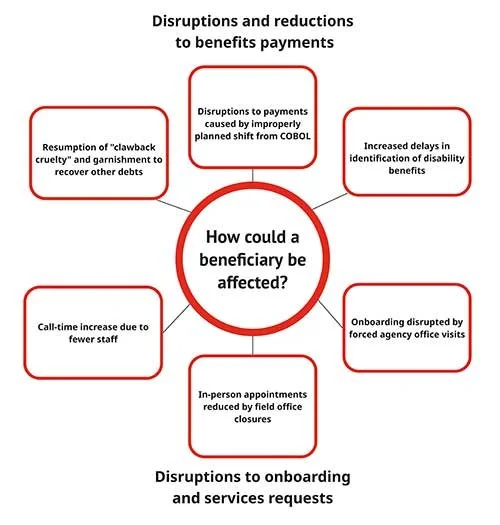
Figure 1: Diagram of how Beneficiaries are affected by the changes to Social Security
Source: Produced by Authors based on Social Security Administration
INTENSIFYING LONG-STANDING ISSUES
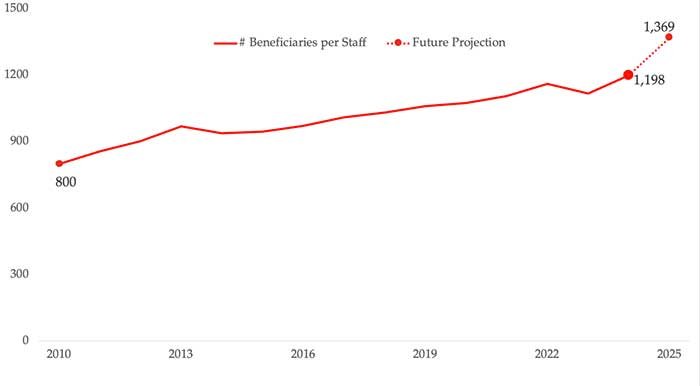
The unfortunate reality of these changes is that they compound long-standing issues faced by SSA that need attention. One such issue is the consistent decline in staff numbers, which have fallen from nearly 68,000 in 2010 to just 57,010 in 2024.21 Simultaneously, the number of beneficiaries has increased from more than 54 million in 2010 to 68.5 million in 2024.22 The number of beneficiaries per staff has thus increased significantly from 800 in 2010 to 1,198 in 2024, and will increase to 1,369 in 2025 assuming all staff cuts are implemented and the number of beneficiaries stays the same. This means that an already overburdened staff will be stretched even thinner.
Figure 2: Beneficiaries per SSA Worker
Source: Produced by Authors from Social Security Administration Data26
Meanwhile, benefits are at risk, as the system will only generate enough revenue to cover about 78% of current monthly benefits in just five years. The serious threats to the functioning of the SSA outlined above require meaningful solutions including raising revenue through easy solutions like removing the cap on social security contributions,23 increasing SSA’s workforce, and implementing meaningful and planned upgrades to services. Instead, the response of the current administration has been the opposite—reducing the workforce and disrupting planned improvements.
Social Security is Foundational, Reliable, and Needed
Social Security is the backbone of retirement savings and financial well-being for older Americans after retirement in the United States. It is reliable because in almost 90 years it has never missed a check.24 And it is needed because of how many households rely on it as their primary or major source of retirement income.
SOCIAL SECURITY HAS NEVER MISSED A PAYMENT
To be clear, Trump and DOGE have not cut or delayed payments to date. The Social Security Administration has not missed payments in its 89 years of existence. The SSA’s system staggers payments based on recipients’ birthdays, with those born in the first 10 days of a month receiving their checks on the second Wednesday, and so on. Supplemental Security Income (SSI) recipients - those most in need - are typically paid at the very first of the month.25 This process helps ensure that payments are made in a timely manner and that the system is not overwhelmed.27
SOCIAL SECURITY IS NEEDED AND RELIABLE
While US Commerce Lutnick and others suggest that delays wouldn’t matter - Lutnick used the example of his mother in law - the data representing Americans tell another story. Social Security is the foundation of retirement security for most American seniors.
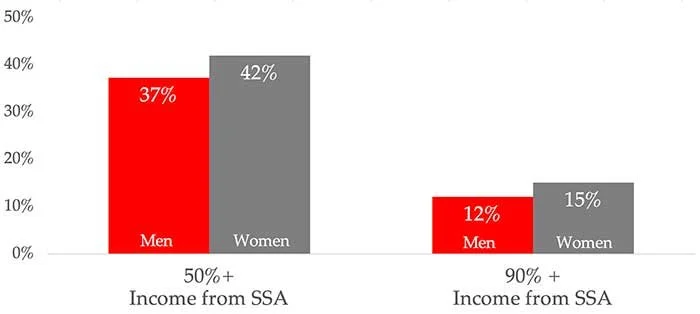
According to the Social Security Administration, nearly 90% of Americans over age 65 receive benefits, and those benefits make up an average of 31% of their income. But for many, the reliance is much deeper: 37% of elderly men and 42% of elderly women count on Social Security for more than half their income. Even more sobering, 12% of older men and 15% of older women rely on it for at least 90% of their income.28
Figure 3: Older Americans Rely on Social Security for their Income
Source: Reproduced using data from Dushi and Trenkamp (2021)
Older women, in particular, are at risk. They tend to earn less over their lifetimes, outlive their spouses, and have less saved for retirement. For American women, Social Security is often not just the main source of income - it’s the only source.29
WHAT HAPPENS IF SOCIAL SECURITY CHECKS GO MISSING?
It would be an emergency for most people if they missed a Social Security check. The average Social Security check for retirement beneficiaries in January 2025 was $197629a. The Federal Reserve has been tracking American financial fragility for years, and the latest data show a stark reality. According to one Fed report, one in three older Americans would be unable to pay for a $2000 emergency,30 which a missed Social Security check would represent.
Another Fed report indicates that 37% of Americans would need to borrow, sell something, or simply not pay when faced with a $400 emergency.31 For millions of seniors, missing a Social Security check would be exactly that kind of emergency.
What is To Be Done for Social Security: Policy Recommendations
Congress and the President should move fast to restore the Social Security system’s capacity before the damage becomes irreversible and creates a crisis for families and communities. Social Security represents promised benefits for which most people have paid money throughout their working lives, and it is imperative that this promise be kept. Key steps that need to be taken include:
REVERSE LAYOFFS
The Acting Commissioner of Social Security should reverse recent layoffs, including the dismissal of cybersecurity officers and thousands of experienced field representatives. Instead, there is a need to hire more workers to fully operationalize the SSA and reverse the general decline in staffing numbers.
CANCEL OFFICE CLOSURES
The Acting Commissioner of Social Security must cancel planned field office closures and expand call center staffing to reduce wait times and restore public trust. The SSA payment system would benefit from a thorough, professional overhaul, approached with careful consideration rather than an overly politicized rush.
BUILD TRUST AND FUND THE SYSTEM
Trust in Social Security took generations to build. It can be lost in a month. The Acting Commissioner, the Trump administration, and Congress have a responsibility to stop the attacks and start to rebuild what has been eroded in just a few short weeks. Rebuilding trust starts with rebuilding capacity.
If there is a positive aspect to be found in this attack on the nation’s most trusted public institution, it’s that there is a renewed and widespread appreciation for Social Security. Congress must rebuild trust, maintain and expand Social Security. Millions of lives depend on it.
Appendix
Date: 30 Jan
Event: Tiffany Flick first approached by Leland Dudek about arrival of DOGE
Context and Impact: In testimony provided in March as part of a Federal Lawsuit, former SSA employee Tiffany Flick describes first being approached by Leland Dudek (then a mid-level senior advisor in the Office of Program Integrity)
that DOGE officials requested to be on-site immediately and that two officials - Michael Russo,and Scott Coulter, would be working at the SSA
Date: 10 Feb
Event: Commissioner's Office receives repeated requests to onboard a DOGE-affiliated software Engineer
Context and Impact: Tiffany Flick testifies that repeated requests to onboard a DOGE software engineer - Akash Bobba - are made, and he's to be given data access by the end of Feb 10th. Mr Russo contacts Leland Dudek and puts together a team to answer DOGE's questions. Flick's testimony describes the team as being unwilling to field help from the Commissioner's Office and only focused on answering DOGE's questions which are based on a fundamental misunderstanding of the SSA system
Date: 14 Feb
Event: Repeated Requests for Data Access and Leland Dudek placed on administrative leave
Context and Impact: Repeated requests are made by the DOGE team for access to SSA data in contravention of SSA norms. As per Tiffany Flick's testimony, Leland Dudek was put on Administrative Leave.
Date: 16 Feb
Event: Acting SSA Commissioner Michelle King Resigns
Context and Impact: Michelle King - an experienced SSA Administrator is informed that Leland Dudek is to be made Acting Commissioner and chooses to resign rather than allowing DOGE access to the SSA system, meaning the SSA loses an experienced administrator
Date: 16 Feb
Event: Leland Dudek Appointed Acting SSA Commissioner
Context and Impact: Leland Dudek is elevated to Acting Commissioner. Dudek was formerly a part of the IT Team, and had only recently been put on administrative leave for improper collaboration with DOGE in violation of data security norms, before his elevation
Date: 18 Feb
Event: Leland Dudek allows DOGE Access to SSA Data
Context and Impact: The previous administrative resistance to allowing DOGE into SSA systems is removed
Date: 21 Feb
Event: Office of Analytics, Review and Oversight restructured
Context and Impact: The Office of Analytics, Reiew and Oversight provided an internal review process for the program's quality and effectiveness. Its removal means a reduction in internal monitoring, an increased burden to other offices which absorb its functions, and the loss of experienced workers
Date: 21 Feb
Event: Agreements with Retirement and Disability Research Consortiums (RDRCs) terminated
Context and Impact: The RDRCs provided valuable external and independent research on how SSA operates; the termination of the cooperative agreements means a reduction of external monitoring and evaluation
Date: 24 Feb
Event: Closure of Office of Transformation
Context and Impact:The Office of Transformation was in the process of modernising systems such as removing the need for wet-ink signatures. Its closure means a delay in modernisation attempts
Date: 25 Feb
Event: Closure of the Office of Civil Rights and Equal Opportunity
Context and Impact: The Office of Civil Rights and Equal Opportunity investigated civil rights complaints and adjudicated disability access. many of its functions were statutory, so its closure means increasing the burden of work on other departments, a loss of expertise, and a delay in statutory functions of the SSA
Date: 27 Feb
Event: Announcement of Options to Encourage Retirement
Context and Impact: The new regime's target of a reduction of workforce is made explicit and paths to achieving a reduction of 7000 workers are provided
Date: 3 Mar
Event: Identification of targets for savings cuts
Context and Impact: The SSA had initially terminated digital enrolment processes for children born in Maine due to a misunderstanding of why people under 18 were receiving SSNs, causing onboarding challenges by requiring parents to visit field offices. This was then reversed, but reflects a misunderstanding of how and why existing systems are in place
Date: 7 Mar
Event: Reversal of cancellation of contracts with Maine on Enumeration at Birth and Electronic Death Registry
Context and Impact:The SSA had initially terminated digital enrolment processes for children born in Maine due to a misunderstanding of why people under 18 were receiving SSNs, causing onboarding challenges by requiring parents to visit field offices. This was then reversed, but reflects a misunderstanding of how and why existing systems are in place
Date: 13 Mar
Event: Implementation of AI system for Hearing Recording and Transcriptions
Context and Impact: The Hearing Recording and Transcriptions (HeART) program is being rolled out nationwide to implement AI-generated transcripts for hearings.
Date: 18 Mar
Event: Enhancement of Identity Proofing Requirements
Context and Impact: Enhanced Identity Proofing Requirements are implemented for all beneficiaries to address allegations of fraud, despite the extremely low rate of fraud related to identity for SSA. This is projected to create additional barriers to receiving benefits for people who do not live near field offices or can reliably use the internet
Date: 19 Mar
Event: Announcement of Cost Reduction Initiatives
Context and Impact: Cost-reduction initiatives are announced in connection to an audit by the Government Accountability Office of the electronic SSN Verification service
Date: 20 Mar
Event: Resumption of Treasury Offset Program Collections
Context and Impact: The SSA has the power to garnish OASDI and SSI benefits to recover debts owed by beneficiaries under the Treasury Offset Program. While this program was temporarily halted, it is now resumed. This will have a direct impact on particularly vulnerable beneficiaries who are often the most likely to have other federal debt obligations
Date: 20 Mar
Event: Judge Intervenes regarding DOGE
Context and Impact: A federal judge halted further record sharing between the SSA and DOGE due to likely violation of privacy laws including through access to Numident, which has extensive personal information. This ruling was informed by testimony from former SSA agents. In response, Acting Commissioner Dudek implies 'shutting down the SSA'
Date: 21 Mar
Event: Acting Commissioner Dudek Clarifies Statement about halting Social Security
Context and Impact: The Acting Commissioner walks back his statements about shutting down the SSA
Date: 25 Mar
Event: Nominated Commissioner Frank Bisignano testifies
Context and Impact: Frank Bisignano, CEO of Fiserv, testifies as the nominee for Commissioner of the SSA. Frank Bisignano denies claims that he had improper contact with both the SSA and DOGE officials, though a whistleblower provides independent corroboration to the Washington Post and Democratic Senators.
Date: 26 Mar
Event: Social Security Updates Recently Announced Identity Proofing Requirements
Context and Impact: The SSA walks back the previous 18th March order on required field office visits for all, and instead allows SSI, Disability, and Medicare beneficiaries to continue to verify via phone. The system remains in place for everyone else
Date: 27 Mar
Event: Correcting the Record about Social Security Office Closures
Context and Impact: The SSA clarifies the extent of its field office closures in response to public backlash and says only one field office is being closed, and a number of hearing rooms. However, this does not conflate with statements on DOGE's "Wall of Receipts"
Endnotes
1. Social Security Administration Press Office (2025, March 29). Press Releases . Social Security Administration.
https://www.ssa.gov/news/press/releases/
2. Qiu, L., & Leventhal, J. (2025, March 28). Assessing Elon Musk’s Misleading Claims About Fraud in Government Spending. The New York Times .
3. Egwuonwu, N., Atkins, C., & Grumbach, G. (2025, March 22). Social Security chief backs down on threat to shut down agency after DOGE ruling . NBC News.
4. Peck, E. (2025, March 21). Seniors won’t complain if they miss a Social Security check, Lutnick says . Axios.
https://www.axios.com/2025/03/21/social-security-lutnick-doge-checks
5. Hinkle, M (2025, Feb 28). Social Security Announces Workforce and Organization Plans . Social Security Administration
https://www.ssa.gov/news/press/releases/2025/#2025-02-28
6. The Social Security Administration’s Workforce Update . (n.d.). Social Security. Retrieved March 29, 2025, from
https://www.ssa.gov/news/workforce/
7. Hinkle, M (2025, Feb 25). Social Security Dissolves Duplicative Office . Social Security Administration.
https://www.ssa.gov/news/press/releases/2025/#2025-02-25
8. Hinkle, M (2025, Feb 24). Social Security Eliminates Wasteful Department. Social Security Administration.
https://www.ssa.gov/news/press/releases/2025/#2025-02-24
9. Hinkle, M (2025, March 27). Correcting the Record about Social Security Office Closings. Social Security Administration.
https://www.ssa.gov/news/press/releases/2025/#2025-03-27-a
10. Kinnard, M. (2025, March 19). A list of the Social Security offices across the US expected to close this year . AP News.
https://apnews.com/article/social-security-offices-closures-doge-trump-b2b1a5b2ba4fb968abc3379bf90715ff
11. Hinkle, M (2025, March 18).
Social Security Strengthens Identity Proofing Requirements and Expedites Direct Deposit Changes to One Day
. Social Security Administration.
https://www.ssa.gov/news/press/releases/2025/#2025-03-18
1 1. O’Malley, M (2024, Nov 13).
SSA 2024 Agency Financial Report.
Social Security Administration.
https://www.ssa.gov/finance/2024/Full%20FY%202024%20AFR.pdf
12. Hinkle, M (2025, March 26). Social Security Updates Recently Announced Identity Proofing Requirements . Social Security Administration.
https://www.ssa.gov/news/press/releases/2025/#2025-03-26
13. O’Malley, M (2024, Nov 13). SSA 2024 Agency Financial Report. Social Security Administration.
https://www.ssa.gov/finance/2024/Full%20FY%202024%20AFR.pdf
14. Anderson, M. (n.d.). Preventing, Detecting, and Recovering Improper Payments. Office of the Inspector General, Social Security Administration
https://oig.ssa.gov/assets/uploads/072401.pdf
15. Hinkle, M (2025, March 7). Social Security to Reinstate Overpayment Recovery Rate . Social Security Administration.
https://www.ssa.gov/news/press/releases/2025/#2025-03-07-a
16. Hinkle, M (2025, March 20). Social Security Administration Resumes Treasury Offset Program Collections After COVID-19 Suspension . Social Security Administration.
https://www.ssa.gov/news/press/releases/2025/#2025-03-20
17. Wettstein, G., & Liu, S. (n.d.). What Is the Risk to OASI Benefits from Unpaid Student Loans? Center for Retirement Research Working Paper Series.
- Hinkle, M (2025, March 21). Social Security Slashes Cooperative Agreements . Social Security Administration.
https://www.ssa.gov/news/press/releases/2025/#2025-02-21
- Dushi, I., Friedberg, L., Webb, A. (2024). How Will COVID-19 Excess Mortality Affect Social Security Benefit Payouts? Michigan Retirement and Disability Research Center Working Paper Series. Michigan Retirement and Disability Research Center
- Hemmeter, J., Mullen, K., & Rennane, S. (2023 ). How do Economic Conditions Affect Earnings and Return to Disability Programs for Beneficiaries whose Benefits were Terminated? NBER Working Paper Series . National Bureau of Economic Research
19. Kelly, M. (n.d.). DOGE Plans to Rebuild SSA Code Base in Months, Risking Benefits and System Collapse. Wired . Retrieved April 1, 2025, from
https://www.wired.com/story/doge-rebuild-social-security-administration-cobol-benefits/
20. Flick, t. (2025, March 7). Affidavit of Tiffany Flick. Filed in United States District Court, District of Maryland Northern Division.
21. Annual Statistical Supplement, 2024—SSA Offices and Staff (2.F1-2.F3). (n.d.). Social Security Administration Research, Statistics, and Policy Analysis. Retrieved April 1, 2025, from
https://www.ssa.gov/policy/docs/statcomps/supplement/2024/2f1-2f3.html
22. Social Security Beneficiary Statistics. (n.d.). Social Security. Retrieved April 1, 2025, from
https://www.ssa.gov/oact/STATS/OASDIbenies.html
23. Ghilarducci, T. (2024). Work, Retire, Repeat. University of Chicago Press.
24. Konish, L. (2025, March 1).
Social Security has never missed a payment. DOGE actions threaten “interruption of benefits,” ex-agency head says
. CNBC.
25.Schedule of Social Security Benefit Payments—2024/2025. (2023). 05–10031 .
26. Social Security phones are down and offices are under strain. The Washington Post. (2025, March 25).
https://www.washingtonpost.com/politics/2025/03/25/social-security-phones-doge-cuts
27. Annual Statistical Supplement, 2024—SSA Offices and Staff (2.F1-2.F3). (n.d.). Social Security Administration Research, Statistics, and Policy Analysis. Retrieved April 1, 2025, from
https://www.ssa.gov/policy/docs/statcomps/supplement/2024/2f1-2f3.html
28. Dushi, I., & Trenkamp, B. (n.d.). Improving the Measurement of Retirement Income of the Aged Population . Social Security Office of Research, Evaluation and Statistics. Retrieved April 1, 2025, from
https://www.ssa.gov/policy/docs/workingpapers/wp116.html
29. National Women’s Law Center. (2021). Social Security is vital to older women’s financial security.
https://nwlc.org/resource/social-security-is-vital-to-older-womens-financial-security/
- What is the average monthly benefit for a retired worker? | Frequently Asked Questions | SSA. (2025, January 2) Social Security.
https://www.ssa.gov/faqs/en/questions/KA-01903.html
- Board of Governors of the Federal Reserve System. (2023). Economic well-being of U.S. households in 2022 .
31. Federal Reserve Bank of New York. (2024). Survey of Consumer Expectations: Credit Access Survey – Financial Fragility .
https://www.newyorkfed.org/microeconomics/sce/credit-access#/financial-fragility1